If you run an SEO agency, this situation probably feels familiar.
A client ends the contract. Then they ask for every login and password connected to their campaign. Backlink accounts. Outreach emails. Tool dashboards. Everything.
At first glance, it sounds reasonable. They paid you. They want access.
But this is where things get tricky.
Handing over raw IDs and passwords is usually not standard practice. In many cases, it is risky, unnecessary, and sometimes even a violation of third-party terms.
Let’s walk through why agencies should not automatically share credentials once a contract ends, and what the smarter alternative looks like.
The First Question: What Exactly Are They Asking For?
Not all accounts are equal.
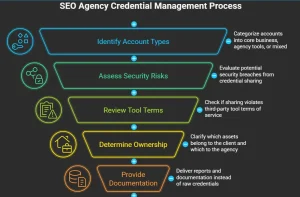
There are generally three categories:
- Core business assets
- Agency tools and infrastructure
- Mixed or operational accounts
Understanding the difference changes everything.
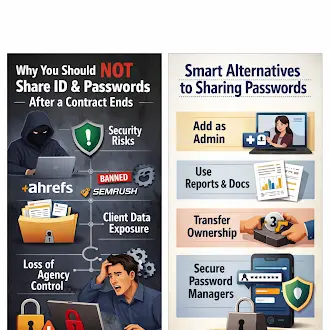
1. Why You Should Not Share Raw IDs and Passwords
A. Security Risks Are Real
Sharing passwords over email or spreadsheets is dangerous.
Once credentials leave your control:
- You cannot track who uses them
- You cannot control future access
- You cannot prevent misuse
If those accounts connect to other client work, your entire system becomes exposed.
Even if the client has good intentions, security breaches happen. You remain responsible if shared access leads to a problem.
B. You May Violate Tool Terms of Service
Most SEO tools prohibit credential sharing.
For example, platforms like Ahrefs and SEMrush license accounts per user or per organization. Sharing logins outside your agency can:
- Breach their terms
- Trigger account suspension
- Lead to permanent bans
If you lose access to your main tools because of one client request, that affects your entire agency.
That risk alone makes password sharing a bad idea.
C. Backlink Infrastructure Is Often Agency Property
Let’s talk specifically about backlinks.
In most agencies:
- Outreach emails are managed centrally
- Publisher relationships are long term
- Guest post accounts are reused
- Negotiated rates are confidential
These relationships and systems are part of your agency’s operational backbone.
They are not the client’s intellectual property.
If you hand over those credentials, you are essentially giving away:
- Your contact database
- Your negotiated deals
- Your network structure
- Your internal workflow
That is like a law firm handing over its entire contact book when a client leaves.
D. Shared Accounts May Contain Other Client Data
This is where things can get legally sensitive.
Many backlink dashboards or outreach inboxes contain:
- Multiple client conversations
- Negotiation history
- Other clients’ URLs
- Financial terms
If you give a client access to that account, you may be exposing third party confidential information.
That can create serious liability under confidentiality obligations.
Even if done unintentionally.
E. It Creates Unnecessary Legal Exposure
When you share passwords, you lose control.
If something happens later:
- A link gets removed
- An account gets banned
- A publisher files a complaint
- Spam is sent from an email
Your agency name may still be associated.
Without clean separation, you risk being blamed for actions you no longer control.
2. What Is Actually Standard Practice?
Let’s separate myth from reality.
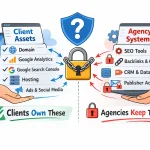
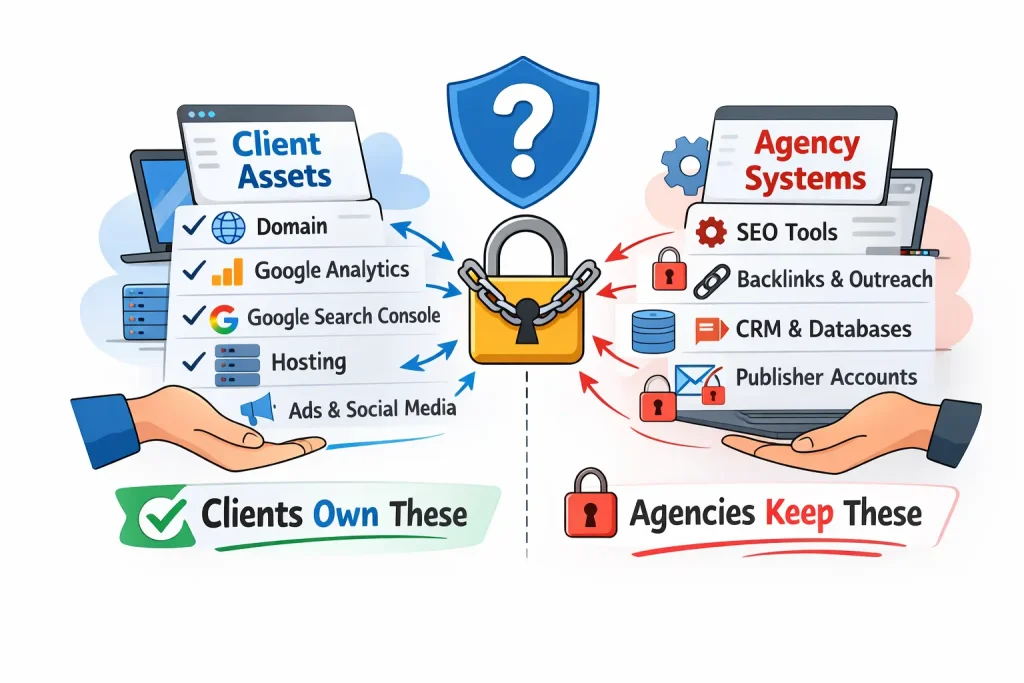
Clients Should Own Core Business Assets
It is best practice for clients to control:
- Domain registrar
- Hosting
- Google Analytics
- Google Search Console
- Google Ads
- Social media accounts
In these cases, you do not share passwords. Instead:
- The client owns the account from day one
- Your agency is added as a user or admin
- When the contract ends, your access is removed
This protects both sides.
Agencies Typically Keep Operational Systems
What usually remains agency property:
- Paid SEO tool subscriptions
- Outreach systems
- Internal CRMs
- Publisher databases
- Prospecting frameworks
- Reusable guest posting accounts
The client pays for outcomes, not for your internal systems.
There is a big difference between:
“I paid for links”
and
“I now own your link building infrastructure.”
3. The Contract Is the Deciding Factor
This is primarily a contract issue, not a criminal law issue.
You should review:
- Ownership clauses
- Work product definitions
- Intellectual property terms
- Termination clauses
If your agreement says “all assets created belong to the client,” you need to interpret what “assets” means.
Usually that includes:
- Published content
- Paid placements
- Reports
- Creative materials
It rarely includes:
- Tool subscriptions
- Logins to third party platforms
- Internal accounts
If your contract is silent, the default interpretation often favors the party who created and maintained the account.
Still, clarity is everything. Future contracts should clearly define:
- What the client owns
- What the agency retains
- What happens upon termination
4. What You Should Provide Instead
Refusing to hand over passwords does not mean refusing cooperation.
A professional transition includes:
- A final backlink report
- Live URLs of placements
- Anchor text details
- Traffic and authority metrics
- Copies of created content
- Campaign documentation
If specific accounts were created solely for the client and contain only their data, you can:
- Transfer ownership
- Change the primary email
- Add them as admin
- Reset credentials securely
The key is structured transfer, not dumping a password list.
5. The Long Term Business Impact
There is also a strategic angle here.
If agencies start routinely handing over:
- Outreach emails
- Publisher logins
- Negotiation threads
They effectively train clients to bypass them.
You stop being a strategic partner and become a temporary middleman.
Your value lies in:
- Systems
- Relationships
- Process
- Experience
Those are legitimate business assets.
Protecting them is not unethical. It is responsible business management.
6. A Smart Way to Respond to Clients
When a client requests credentials, avoid sounding defensive.
Instead, respond clearly and calmly:
- Confirm that they will receive full access to all business owned accounts
- Clarify that agency tools and infrastructure remain internal property
- Offer full documentation and reporting
- Propose a structured transition plan
This shows professionalism, not resistance.
Most reasonable clients understand once you explain the distinction.
Handing over every ID and password at the end of a contract might seem like the easy option. It avoids conflict in the short term.
But in reality, it can:
- Violate third party terms
- Expose confidential data
- Damage security
- Undermine your agency’s value
- Create legal risk
The smarter approach is simple:
Clients own their business assets.
Agencies retain their operational systems.
Work product gets delivered clearly and professionally.
If you run an SEO agency, protecting your infrastructure is not just about control. It is about security, compliance, and long term sustainability.
And that is something worth defending.